dimanche 30 septembre 2012

Today is the last day of free shipping for all orders from Amber Regina
www.amberregina.com
Use the coupon shipping55 at checkout

Follow us of Facebook for future deals and promotions!

Amber : Talismanic, Amuletic and Folk Medicine


Since time immemorial, amber has been worn as an amulet in the Baltic as well as the Mediterranean cultures. The people of these cultures believed amber was especially beneficial for protecting infants from the croup when worn as a necklace in the form of an amulet. As a charm, amber was believed to ward of fits, dysentery and nervous afflictions. As early as Pliny’s time, farmers wives in areas where the “water had properties that would harm the throat”, or was deficient in iodine, wore raw amber beads around their necks as a remedy against swellings (goiter).

raw baltic amber butterscotch beads


The lore attributing guardian values to amber has lasted into the 20th century. During the late 1960s, for example, an authority announced the virtues of wearing amber beads around the throat to protect it from diseases. It was believed that the strong electrical properties of amber resulted in an electrical band forming around the throat and bringing into existence a protective power. Even today, in many of the peasant areas of the Baltic, amber earrings and necklaces are worn when one has a headache or a throat ailment.

Amber is thought to possess other unusual curative powers. In ancient times, amber was powdered and mixed with honey and oil-of-roses for curing ear troubles. When mixed with honey from Attica, it was a cure for dimming eyesight. The powder was taken internally as a remedy of diseases of the stomach, whereas the amber oil was prescribed for internal administrations of asthma and whooping cough. Simply holding a ball of amber in the hands not only kept one cool during the hottest days of summer, but would reduce the temperature of a person from fever.

yellow lemon amber nugget


Many prescriptions were written which included amber along with other gemstones. An old meteria medica lists 200 medicinal stones. A dose suggested for heart disease contained white amber, red coral, crab’s eyes, powdered hartshorn, pearls and black crab’s claws. Such a mixture was the prized Oriental Bezoar, prescribed for different ailments.

Amber was also used externally as a fumigation to cure other ailments, including tonsillitis, catarrh, or running nose and eyes. It was thought that the smell of burned amber helped women in labor. In the Orient, amber fumigation was accomplished by throwing powdered amber on a hot brick. The fumes would strengthen the individual and give him courage from the soul of the tiger, a beast second in importance only to the dragon in Chinese mythology. “Syrup of amber”, a mixture of liquid acid-of-amber and opium, was also used in China as a sedative, anodyne and antispasmodic drug. Powdered amber and oil-of-amber were prescribed as powerful diuretics.

powdered Baltic amber


A piece of amber placed on the nose was thought to stop excessive bleeding. It is perhaps this belief in the special blood-stilling or coagulating properties of amber that explains the use of an amber handle on the ritual Jewish circumcision knife of the 18th century. During the early 1900’s, as medical practices advanced, vessels made of compressed amber were used during blood transfusion. The amber, being a poor conductor of heat, kept a more constant blood temperature for a longer period of time that did glass or stone vessels, and thus the blood was kept from coagulating.

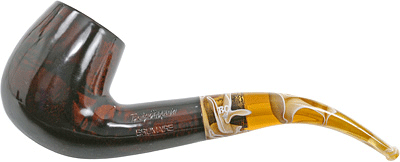
The persistent belief that amber not only prevented infections, but acted as a charm against them, was the reason amber retained its popularity into the late 1800s and early 1900s, especially in the smoking articles industry. Its employment as a mouthpiece for cigars, cigarettes and pipes was originally talismanic. Amber was used in the Middle East for the mouthpieces of hookahs with their many hoses because of the gemstone’s supposed germicidal effect. 

Butz-Choquin Brumaire pipe in amber

dimanche 1 avril 2012

What is Amber?


Amber is one of a few gemstones of organic, rather than mineral, origin. Essentially, amber is a fossilized resin from prehistoric evergreens or other now-extinct species of resin-producing trees which flourished in large forests 40-60 million years ago.

As the resin flowed downward, it occasionally entrapped insects and plant species, and eventually accumulated in masses of various sizes and shapes that later became buried in the soil below the trees. Extreme conditions, such as pressure by glacier covering, severe climatic changes and submersion of the resin under salt water, took place over million of years, causing the process of oxidization. The volatile compounds which imparted “stickiness” to the resin escaped so slowly the resin was prevented from cracking into numerous minute fragments as a result of the shrinkage. During the lengthy time underground, molecules were forced to polymerize; that is, to rearrange themselves. This caused a metamorphosis from a tacky resin to a solid, forming a compound with greater stability and hardness than the original substance, and similar in appearance to plastic (in no way is amber identical – chemically or otherwise – to plastic, though plastic often masquerades as amber to the unsuspecting public).

Rough or “block” amber is commonly found in irregular lumps or rounded nodules, also in grains, drops and stalactitic masses. Pieces are generally small weighing up about 200 grams, although considerably larger masses have been found.


Amber is commonly yellow to honey-colored, but its hues range from white to light yellow (butterscotch) to reddish brown and green. Sometimes it is so pale that seems colorless. Approximately 250 different color varieties are known. In addition to variations of color, amber can be absolutely transparent or completely opaque. 


When chips of amber are burnt, a smoke with pleasant resinous odour of pine is emitted, and for this reason amber was burnt as incense in temples in the Far East. If a lump of amber is rubbed vigorously, it produces enough negative static electrical charge to pick up small particles of tissue paper. The word electricity was actually derived from electron, the Greek name for amber. Unlike other minerals gemstones, amber is warm to the touch, since it is a poor conductor of heat.

Amber is water-insoluble tree resin which has attained a stable state after various changes due to loss of volatile constituents, processes such as oxidization and polymerization, and lengthy burial in the ground. The botanist is not concerned with the length of time to reach this state. It may take a year, thousands years, million years or more. The geologist considers amber to be a fossil tree resin, “fossil” meaning evidence of prehistoric life. The resin, then, must have been excluded from the tree at least before recorded history. The purist places even more restrictions up on the term amber. For him “true amber” is the fossil resin containing as much as 3% to 8% succinic acid (hence known as succinite) and coming from trees which flourished along shores of the Baltic Sea as long ago as 60 million years.

Gem-dealers and jewellers obviously are purists, since one pays the highest price for Baltic Amber. The geologist works to establish the age of the deposits in which the amber is found. The geologist works to establish the age of the deposits in which the amber is found. He also attempts to characterize the amber by its physical and chemical properties, and leans heavily upon aid from organic chemists to accomplish this. The botanist, naturally, is interested chiefly in the botanical sources of amber.


Patty C. Rice, Ph.D.

lundi 17 octobre 2011

Astrological Significance of Amber


Most gems have been related to astrological signs and have significance for astrological readings. In ancient times, the celestial bodies were deemed to impart their powers to certain gems, which would then assist in exerting an influence on mortals wearing them. Amber, for example, was associated with the sign of Leo, because of its golden color. People born under the sign of Leo were protected by the wearing if amber, but those born under the sign of Taurus would be harmed y wearing it. It is used in reference to water signs, such as Cancer, Pisces and Scorpio, since amber is closely associated with the sea. Therefore, amber’s protective qualities would e most beneficial to those born under these water signs – the Scorpios benefiting most from reddish ambers, while Cancers should select the white or water-clear varieties. Dreams which include amber signify that one will embark on a voyage in the future. Amber is specifically associated with the proper name Anne, and those bearing that name will be protected and kept free from illness by wearing any form of the gemstone. The ancient belief led to the custom of wearing a stone assigned to that constellation, or a “birthstone”, which served as an amulet bringing good fortune and protection to its wearer. Amber is considered by some to be the alternate birthstone for November, since its color resembles that of the topaz, the regular birthstone for that month. Amber is also the gemstone for the tenth wedding anniversary. 

From "Amber: the Golden Gem of the Ages" by Patty C. Rice


mardi 11 octobre 2011

Baltic Amber Charm Beads : How Are They Made and What Are They Worth?


Amber is a fascinating material not only because of its age (between 40 and 50 million years old), but also for its qualities. Amber is very pleasant for wearing thanks to its lightness. It’s not a rock, so it really does not matter how large your amber jewelry: even the chunkiest piece would feel like a feather in comparison to other gem stones. Only setting materials like silver or gold can make it feel heavier.


Charm beads made out of Baltic Amber are a real treat. They roll around your wrist or neck warming with your skin creating a pleasant sensation that you wear something truly yours. Many books are written on healing power of amber like its use for rheumatism and arthritis treating (that is why it is recommended for people over 50), ears, teeth, eyes and stomach-aches relief thanks to the natural minerals fermented and petrified in fossilized tree resin that is amber. It is up to you to believe it or not, but the truth is that it is always a bit “disappointing” to take off you amber beads bracelet in the end of the day. You feel like to give away some part of your energy, accumulated in the amber during the day.


Amber is hard to work with: it is a brittle material (hardness 2+), so it might crack or break. Before a beautiful bead created, jeweller has to evaluate the raw material. If there are inner cracks, the stone is not a workable stone for carving and drilling. Since there are so many ways of treating and working of Baltic amber, charm beads can be as diverse as any other amber jewelry.

Each bead is made individually by hand and there is little machinery involved in the process of charm beads making: mainly for cutting, drilling, polishing and faceting the ready product.  

Customers often ask me what is worth of buying: treated amber beads or untreated. Baltic amber as it is found in nature looks dull. Only hours of cleaning, working, polishing and eventual treating to make the color more intense (which sometimes can take days) creates gorgeous pieces with sparkles and bubbles which you enjoy wearing. 100% natural untreated beads come only in Butterscotch, Lemon  and a little part of Green beads with inclusions. All other hues undergo certain treatment. Treating can affect the amber price too: imagine that someone spent hours creating something that looks like a trapped sunray, playing with light and giving gorgeous reflexions. It is definitely harder than just to take a raw piece, drill it and put on a cord. Hundreds years ago Prussian craftsmen developed numerous techniques of treating amber in order to make a piece of jewelry shimmer and shine. They even boil amber in oil for long hours to remove imperfection! Follow your heart: buy amber which grabs your attention, goes with your complexion or style.


There are a few companies that make charm beads. Trollbeads is probably the most famous. Also because they are famous their prices can reach $60 per piece since the beads are made by designers and, certainly, stamped by desired Trollbeads mark. The techniques they use are absolutely identical to those as used in small amber workshops in Lithuania. Trollbeads also made one-of-a-kind beads of exceptional design and fancy faceting. But keep in mind that you pay 90% for the brand.

Here is Amber Regina's collection of Baltic Amber Charm Beads


mercredi 7 septembre 2011

Properties of Amber


Amber is the hardened and fossilized resin of certain pine trees such as the Pinus succinifera.
Amber is either collected from sea shores or fished off the waters, or it is mined byopen - pit mining. Yellowish-brown or honey color is the best known color for amber which are fished or mined along the coasts of Baltic Sea, these are popularly known as Baltic amber. Natural ambers are very old from hundreds to millions of years. Inclusions like frog, butterflies, lizards, spiders, ants, mosquitoes and other insect species inside amber decides its worth.
Copal resin (kauri gum) has similar appearance (simulant) that of an amber stone which is generally confused with real amber and mistakenly used in jewelry asamber beads.
Separation of real amber from plastic (imitation) amber.
S.G.
Amber1.08floats
Salt Water1.12liquid
Plastic1.20sinks
Take a glass of water and add 2 spoon of salt in it. Now dip amber and plastic inside this saturated salt solution. According to Archimedes Principle, which states that, if the S.G. of the stone is greater than that of the liquid it will sink and if the S.G. of the stone is less than that of the liquid it will float. Therefore, amber starts to float on saturated salt solution while plastic sinks. This test is only for separation of amber from plastic and confirms that amber floats in saturated salt solution. Real amber having inclusions of insects may react differently to this test.


Properties
Chemical Composition: 
C10H16O + H2S (approx.) as mixture of hydrocarbons, plus resins, succinic acid and oils
Classification / Type: 
Types of Amber:
  1. Sea Amber: found in the sea or washed up on the shore.
  2. Pit Amber: dug up form pits.
Colors / Varieties: 
Yellow, brown, red (sourced from Myanmar), orange. Color depends on source and impurities. Transparency: Transparent to opaque. Transparency depends on gas bubbles.
Crystal System / Forms: 
None. Amorphous.
Hardness: 
2 - 2.5
Specific Gravity: 
1.05 - 1.09 (usually 1.08)
Cleavage / Fracture: 
None / Conchoidal.
Optic Character: 
Usually an aggregate (A.G.G.) or strong A.D.R. reaction. But, may show any reaction.
Lustre: 
Resinous or greasy.
Refractive Index / Birefringence: 
±1.54 / Nil.
Pleochroism: 
None
Dispersion: 
None
Magnification: 
Amber is noted for its inclusions which are chiefly insects and leaves, gas bubbles, flow lines, other natural inclusions such as pyrite, calcite, etc.
U.V. Fluorescence: 
Bluish white in shortwave and yellow in longwave.
Spectrum: 
Not diagnostic.
Treatment (Enhancement): 
  • Coating: darker colored materials are coated over the surface.
  • Colorless and colored impregnation: to improve the clarity using rape seed oil. Color staining is done to get aged amber and also other colors.
  • Heating: darkens the color in some varieties of amber, clarifies cloudy varieties with plenty of gas bubbles by heating in oil and causes stress cracks to form which is know as sun spangled amber.
Specific Tests & Remarks: 
  • Amber floats in a saturated salt solution.
  • Amber, pressed amber and copal resin break away in powdery splinters or chips with a knife and exhibit static electricity when rubbed.
  • Amber, when burnt emits an aromatic odour.
  • Amber does not soften with ether.
  • Amber softens at about 150°C and melts at 250°C - 300°C.
  • Amber often darkens with age to a fine red brown color.
Synthesis: 
Not commercially synthesized.
Simulants (with key separation tests): 
  • Pressed amber (amberoid): May show elongated gas bubbles and flow lines, outlines of varying clarity of each of the pieces pressed may be seen. Under longwave ultra violet lamp it may show blue white fluorescence. It is not affected by ether or acetone.
  • Copal resin: A drop of ether or acetone will soften and form a stick path. Under shortwave ultra violet lamp it exhibits strong white fluorescence.
  • Plastic (bakelite, celluloid, etc.): Higher S.G. than amber. Peels with a knife and floats in a saturated salt solution.
  • Glass: R.I. & S.G.
  • Chalcedony: S.G. Structure
Geological Occurrence: 
In sedimentary deposits and on shore lines.
Sources: 
  • Along the coasts of the Baltic Sea, where 90% of gem quality amber is fished or mined.
  • Other sources include Sicily, Romania, Dominican Republic, Mexico, Hawaii, Myanmar (red amber with higher S.G.), etc.
Cuts & Uses: 
Mostly as cabochons, beads, carvings, etc.

Please visit our 100% genuine Baltic amber jewelry web store at www.amberregina.com


Source: http://www.gemstonebuzz.com/amber

mercredi 6 juillet 2011

Amber Names

There is no other stone in the gem world which would have so many names in different languages and so many meanings thanks to its origin, natural qualities, trade and general history.

The Greek word ηλεκτρον (electron) was connected to the Sun God, one of whose titles was Elector or the Awakener. The modern terms "electricity" and "electron" derive from the Greek word for amber and come from William Gilbert's research showing that amber could attract other substances.

The English word amber derives from the Arabic anbar, through Medieval Latin ambar and Old French ambre. The word originally referred to a precious oil derived from the Sperm whale. The sense was extended to fossil resin circa 1400, and this became the main sense as the use of ambergris waned. The two substances were confused because they both were found washed up on beaches. The word "ambar" was brought to Europe by the Crusaders.

“Amber” is mainly a female name of French origin, in contemporary language meaning “precious jewel” or “amber colored”.

The German word Bernstein and the Polish bursztyn both mean “burning stone”. They originate from natural quality of amber to burn.

In Finnish (meripihka)and Estonian (merevaik) languages amber stands for “sea stone”. The Lithuanians often name amber baltas referring to their native Baltic sea from where amber nuggets are washed away in abundance.

In Scandinavian languages, like in Danish rav, derives from such suspicious definitions as “thief” or “robber”. The name was given to amber for its electrostatic ability to attract, thus “steal”, light pieces.

The Russian янтарь (“yantar’”) emerged from Lithuanian gintaras meaning “protection against all diseases”, which emphasises healing qualities of amber.