mercredi 6 juillet 2011

Amber Names

There is no other stone in the gem world which would have so many names in different languages and so many meanings thanks to its origin, natural qualities, trade and general history.

The Greek word ηλεκτρον (electron) was connected to the Sun God, one of whose titles was Elector or the Awakener. The modern terms "electricity" and "electron" derive from the Greek word for amber and come from William Gilbert's research showing that amber could attract other substances.

The English word amber derives from the Arabic anbar, through Medieval Latin ambar and Old French ambre. The word originally referred to a precious oil derived from the Sperm whale. The sense was extended to fossil resin circa 1400, and this became the main sense as the use of ambergris waned. The two substances were confused because they both were found washed up on beaches. The word "ambar" was brought to Europe by the Crusaders.

“Amber” is mainly a female name of French origin, in contemporary language meaning “precious jewel” or “amber colored”.

The German word Bernstein and the Polish bursztyn both mean “burning stone”. They originate from natural quality of amber to burn.

In Finnish (meripihka)and Estonian (merevaik) languages amber stands for “sea stone”. The Lithuanians often name amber baltas referring to their native Baltic sea from where amber nuggets are washed away in abundance.

In Scandinavian languages, like in Danish rav, derives from such suspicious definitions as “thief” or “robber”. The name was given to amber for its electrostatic ability to attract, thus “steal”, light pieces.

The Russian янтарь (“yantar’”) emerged from Lithuanian gintaras meaning “protection against all diseases”, which emphasises healing qualities of amber.   


mercredi 18 mai 2011

The Amber Road

As desire for amber circled the world, a need to transport it as a saleable good developed. As the markets grew, so did the transportation system. An Amber Road was established.

This transcontinental trade route coincided with the Baltic Bronze Age, when amber was traded for tin and copper. Amber was initially traded to central European cultures, then sent to Mycenaea and Greece via the Amber Road. According to Marija Gimbutas, a Lithuanian anthropologist, it began 1600 B.C., according to finds in Mycenaenan tombs.

The Amber Road was a system of waterways and ancient highways that for centuries spanned Europe, expanded into Asia, and returned. It also stretched from northern Europe to the Mediterranean Sea. Amber was transported from the North Sea and Baltic Sea by numerous rivers and over land to the rivers of Italy and Greece, onto the Black Sea, and across the Mediterranean Sea to Egypt.


In Roman times, one route moved amber from the Baltic coast into Prussia, through Bohemia, and on to the Adriatic Sea. Here it was sent on to the temple of Apollo at Delphi as an offering to the gods. Earlier, amber had made its way into Egypt where Tutankhamen had it placed among his burial goods. Amber that made its way to the Black Sea would continue on to Asia the Silk Road and be enjoyed by even more cultures.

With the demise of the Roman Empire by the early fifth century A.D., the Dark Ages set in and the road became less important. Literary references to amber and its route disappear, but the people still retained their love of the stone. During the medieval period the road was slowly re-established, but never regained its importance as a major trade route.

The Amber Road has been credited with expanding trade between people whose paths may never have crossed, except for their desire to buy and sell this material. Discovering the path that amber took helps to understand how civilizations spread.

Scandinavian countries especially prized amber and were part of the amber trade. Along with amber came European ideas that influenced their civilization, such as being credited with giving rise to the Nordic Bronze Age. This simple, organic stone had lasting impact on many civilizations.


From “Amber: Jewelry, Art & Science” by Nancy P.S.Hopp, 2009

samedi 7 mai 2011

The Preparation and Working of Amber


Clarification

That cloudy amber could be clarified apparently was known as early as the first century, for Pliny, in his Natural History, mentioned that pieces of amber were “dressed by being boiled in fat of a suckling pig by Archelaus, King of Cappadocia”. This is thought to be the first attempts at clarifying amber. It was Johannes Wigand, in 1590, who discovered other oils could be used rather than the “fat of suckling pigs”, and, by the end of the 17th century, methods of ridding amber of internal obscuration had been well established.


Heat Treatment

To produce a rich brown “antique” color, amber is imbedded in pure sand in an iron pot, then increasingly heated for 30 to 40 hours. The resulting rich brown color closely resembles the oxidized amber hues produced by aging. Such treated amber is often sold under the term “antiqued amber”.

An unheated autoclave or “pressure cooker” is used to drive the oil into air pockets of the porous material to produce clarification. Next, the amber is placed in an electric oven and gradually heated to soften it. During this stage, any air bubbles left within the mass of amber expand to form discoidal fractures. At the same time, heating speeds the process of oxidation and causes the amber to deepen in color. Oxidation occurs from the outside in, causing outer layers to be generally darker than the cores. The longer amber is heated, the darker it becomes. After porous pieces have been subjected to this treatment, they tend to be harder and more durable than they were previously. This process produces beautiful amber, in great demand by amber connoisseurs, and one which is still considered to be genuine amber. It is most commonly found in the finished pieces imported into the USA and Western Europe.

mardi 15 mars 2011

Clear Amber

Clear or transparent amber takes a high polish and is in great demand for making faceted beads. Since the era of the amber guilds of the Middle Ages, amber beads - as meticulously as any other transparent semi-precious gem - were produced in great quantities by skilled craftsmen. During the 1920s, when amber was second only to diamonds in the United States gem imports, much of the clear amber imported was in the form of faceted beads, and these can still be found in antique shops. The USA importers tended to favor clear, golden varieties, and this is the hue most often thought of when speaking of amber.


The clear or partially clear shelly amber is rarely cloudy throughout and seldom contains cloudy layers as does massive amber. Transparent specimens range in hue from almost colorless to dark reddish yellow. The "water-clear" amber is very rare. Most frequent are "yellow-clear" colors.

http://www.amberregina.com/catalog.php?item=9

lundi 14 mars 2011

Golden Gem of the Ages

Eurtmachus
Received a golden necklace, richly wrought,
And set with amber beads, that glowed as if
With sunshine.

Homer


Amber, a gemstone sought after by ancient Stone Age sun worshippers because its beautiful radiance resembled the sun's rays, well deserved the tittle, "golden gem of the ages". In the civilizations of the early Greeks and Romans, amber was so revered it was available only to nobility. Ladies of the Roman court desired it for its brilliant hue and for the protection from evil spells which it was believed to bestow upon wearer. In reverence to its talismanic powers, gladiators wore amber amulets when venturing into the Coliseum. Throughout Europe, amber was worn as protection against various and sundry illnesses.

Although ancient man and the peoples of many later civilizations treasured amber as highly as gold, little was known of its origin until the age of science brought proof that it originated from the sticky resin which flowed from prehistoric trees. Few gems match amber in respect of its mode of creation, the depth of its history and its transmission of aesthetic pleasure to man. None can match it in the range of human knowledge and scientific information its study reveals.


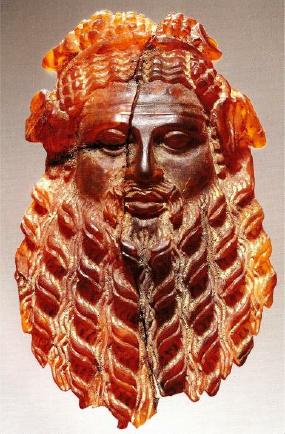
                                           Amber mask of Dionysos, Roman, 1st Century

Over the centuries, amber primarily came into the hands of man from the seashore and outcroppings of amber-bearing strata near the Baltic Sea; however, small deposits have been found in other places throughout the world. By the late 1800's, the Baltic amber industry had become highly organized, with extensive mining taking place in East Prussia, a region which is now part of Poland, the Kaliningrad Oblast of the Russian Federation. During the 1800s, scientists began studying the insects and other evidences of fauna and flora of the past entrapped in amber resin as it flowed from trees and primeval forests in the "Amberland" of the Baltic.

Thus, amber is valued more than ever - not only by connoisseurs and collectors, but also by paleobotanists and paleozoologists, not to mention geologists, archaeologists, anthropologists and ... women who enjoy wearing gorgeous amber jewelry.

jeudi 10 mars 2011

The Curious Lore of Amber

Oh, listen in the evenings,
When the sea is restless
And sprays the shore with amber
The depths unseen palm...
Maironis (Lithuanian poet, 1862 - 1932)

For many centuries, cultures acquainted with amber wondered what this beautiful gift of nature was and how it originates. True to the customs of the times, many myths and legends resulted from attempts to explain the origin of this mysterious substance. Most of the folklore was simply carried from generation to generation by word of mouth. Some legends found their way in literature of antiquity and are preserved for us today in their poetic versions.

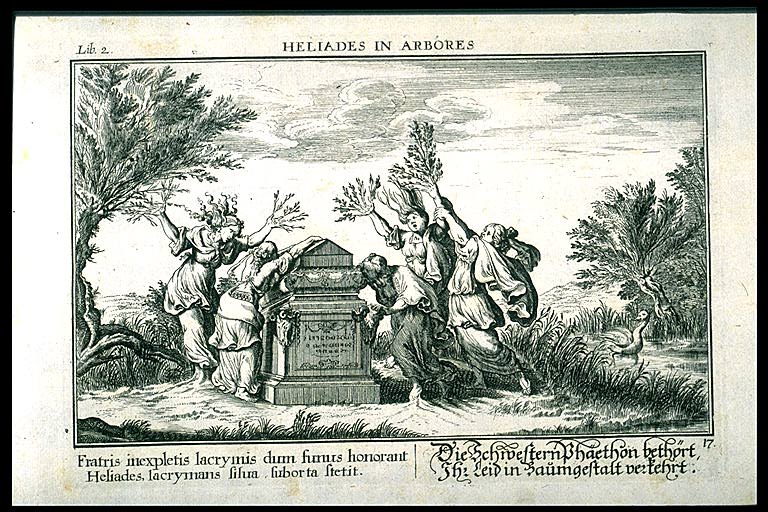
It was the Roman poet Ovid who recorded the prevalent Greek myth, the Tears of Heliades, attributing divine origin to amber. The Greek legend recounts the adventure of Phaethon, who grew to young manhood without knowing that one of his parents was immortal. Prevailing upon his mother, Clymene, to inform him who his father was, Phaethon was astonished to discover that he was the child of the sun god, Helios. Doubting his mother's word, he sought out the Sun God to seek proof of his parentage.


Phaethon travelled to India, where Helios' palace stood splendidly, glimmering with precious stones and gold. Upon entering the hall, the biy was blinded by light from the Sun God and found it impossible to see. But upon seeing Phaethon, Helios dimmed his radiance and commanded Phaethon to approach.

Phaethon demanded: "Helios, if you truly are my father, what proof will you give so I may be known as your son? "
"You deserve not to be disowned, my son. Whatever you ask I will grant you", promised Helios.
Thereupon the boy asked to be permitted for one day to drive the flaming chariot of the sun across the arch of the heavens.

Knowing the great dangers involved, Helios offered Phaethon other gifts, but possessing the willfulness of youth, Phaethon could not be deterred. With great reluctance, Helios gave his consent.

On the appointed day, the daughters of Helios, the Heliades, helped Phaethon yoke his father's steeds to the chariots. As dawn opened the doors of the east with the stars and moon retiring, Phaethon leaped into the golden chariot. Delightedly grasping the reins of the fiery horses, he sped off to the west. Soon the palace was far behind him as the impassioned horses sprang swiftly forward, outrunning the morning breezes.

Feeling a lighter load than usual, the horses soon realized that inexperienced hands held the reins, and they ran wild, straying far from the travelled path. Seized with fear, poor Phaethon forgot his horses' names and knew not how to guide them. He dropped the reins in terror on the height and became overwhelmed with dizziness. The uncontrolled steeds dashed on without restraint, rushing hither and thither, wherever they chose. As they approached too near the Earth, clouds began to smoke, the harvest blazed, fields were parched and the rivers dried up. Even the sea shrank because of the awful heat.

Fearing the world would be reduced to ashes, the Goddess of Earth begged Jupiter to take pity and give her relief. In an effort to save the Earth, Jupiter launched a thunderbolt at Phaethon, causing him to fall headlong and flaming into the Eridanus River. Finding him dead, the river nymphs reared a tomb to Phaethon's memory along the shore.


Lamenting Phaethon's death, his sisters, the Heliades wept bitterly. As punishment for encouraging Phaethon's reckless ride and for assisting him in yoking the steeds to the chariot, the Heliades became rooted to the spot and changed into poplar trees, from which tears continually fell. These tears became hardened by the sun and turned into amber.

dimanche 27 février 2011

"Three Colors: White"

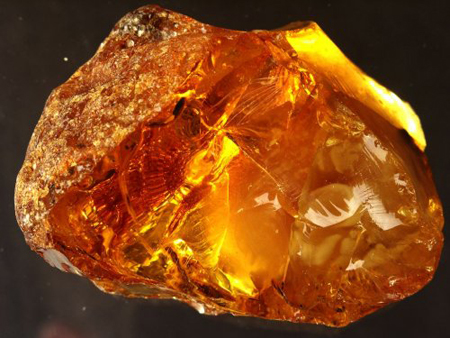
Baltic Amber is thought to be honey or whisky colored. But within the range of these hues are many subtle variations. In fact, the hues range from light yellow to dark brown and include lemon yellow, orange, reddish brown and hues that are almost white. Some are so pale the amber seems colorless. 


Many people when seeing white amber do not realize that white color is a "normal" amber color, although very rare (about 2-3% of all Baltic amber). Usually this amber is distinguished by its variety of textures and "natural ornamentation". Amber of this colour is also called "Royal" or "Bony". It could be with some "colorful intrusions" (yellow, black, blue, green, transparent amber) with interesting patterns. 

Jewelry made out of white amber has a very "young" look: it is light and has a smooth creamy surface with yellow, grey or even blue swirls that create unique patterns. These dark speckles result from fossilized pine needle inclusions. White amber is used in combination with cherry to achieve a contrast of dark and light.

Add caption
http://www.amberregina.com/catalog.php?item=27

          To buy authentic White Baltic Amber Jewelry
http://www.amberregina.com/catalog.php?keyword=white+amber&cond=advand&category=&price=