Affichage des articles dont le libellé est baltic amber. Afficher tous les articles
Affichage des articles dont le libellé est baltic amber. Afficher tous les articles
jeudi 24 avril 2014

vendredi 22 février 2013
What is Amber
I am very pleased that Cattie Coyle invited me to write an article in her blog on Baltic Amber.
Check it out!
Check it out!
 |
| Baltic Amber pendant with a mosquito |
mardi 11 octobre 2011
Baltic Amber Charm Beads : How Are They Made and What Are They Worth?
Amber is a fascinating material not only because of its age (between 40 and 50 million years old), but also for its qualities. Amber is very pleasant for wearing thanks to its lightness. It’s not a rock, so it really does not matter how large your amber jewelry: even the chunkiest piece would feel like a feather in comparison to other gem stones. Only setting materials like silver or gold can make it feel heavier.
Charm beads made out of Baltic Amber are a real treat. They roll around your wrist or neck warming with your skin creating a pleasant sensation that you wear something truly yours. Many books are written on healing power of amber like its use for rheumatism and arthritis treating (that is why it is recommended for people over 50), ears, teeth, eyes and stomach-aches relief thanks to the natural minerals fermented and petrified in fossilized tree resin that is amber. It is up to you to believe it or not, but the truth is that it is always a bit “disappointing” to take off you amber beads bracelet in the end of the day. You feel like to give away some part of your energy, accumulated in the amber during the day.

Amber is hard to work with: it is a brittle material (hardness 2+), so it might crack or break. Before a beautiful bead created, jeweller has to evaluate the raw material. If there are inner cracks, the stone is not a workable stone for carving and drilling. Since there are so many ways of treating and working of Baltic amber, charm beads can be as diverse as any other amber jewelry.
Each bead is made individually by hand and there is little machinery involved in the process of charm beads making: mainly for cutting, drilling, polishing and faceting the ready product.
Customers often ask me what is worth of buying: treated amber beads or untreated. Baltic amber as it is found in nature looks dull. Only hours of cleaning, working, polishing and eventual treating to make the color more intense (which sometimes can take days) creates gorgeous pieces with sparkles and bubbles which you enjoy wearing. 100% natural untreated beads come only in Butterscotch, Lemon and a little part of Green beads with inclusions. All other hues undergo certain treatment. Treating can affect the amber price too: imagine that someone spent hours creating something that looks like a trapped sunray, playing with light and giving gorgeous reflexions. It is definitely harder than just to take a raw piece, drill it and put on a cord. Hundreds years ago Prussian craftsmen developed numerous techniques of treating amber in order to make a piece of jewelry shimmer and shine. They even boil amber in oil for long hours to remove imperfection! Follow your heart: buy amber which grabs your attention, goes with your complexion or style.

There are a few companies that make charm beads. Trollbeads is probably the most famous. Also because they are famous their prices can reach $60 per piece since the beads are made by designers and, certainly, stamped by desired Trollbeads mark. The techniques they use are absolutely identical to those as used in small amber workshops in Lithuania. Trollbeads also made one-of-a-kind beads of exceptional design and fancy faceting. But keep in mind that you pay 90% for the brand.

lundi 14 mars 2011
Golden Gem of the Ages
Eurtmachus
Received a golden necklace, richly wrought,
And set with amber beads, that glowed as if
With sunshine.
Homer

Amber, a gemstone sought after by ancient Stone Age sun worshippers because its beautiful radiance resembled the sun's rays, well deserved the tittle, "golden gem of the ages". In the civilizations of the early Greeks and Romans, amber was so revered it was available only to nobility. Ladies of the Roman court desired it for its brilliant hue and for the protection from evil spells which it was believed to bestow upon wearer. In reverence to its talismanic powers, gladiators wore amber amulets when venturing into the Coliseum. Throughout Europe, amber was worn as protection against various and sundry illnesses.
Although ancient man and the peoples of many later civilizations treasured amber as highly as gold, little was known of its origin until the age of science brought proof that it originated from the sticky resin which flowed from prehistoric trees. Few gems match amber in respect of its mode of creation, the depth of its history and its transmission of aesthetic pleasure to man. None can match it in the range of human knowledge and scientific information its study reveals.
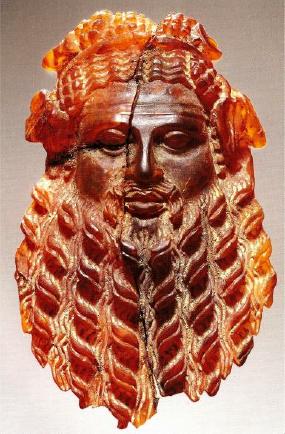
Amber mask of Dionysos, Roman, 1st Century
Over the centuries, amber primarily came into the hands of man from the seashore and outcroppings of amber-bearing strata near the Baltic Sea; however, small deposits have been found in other places throughout the world. By the late 1800's, the Baltic amber industry had become highly organized, with extensive mining taking place in East Prussia, a region which is now part of Poland, the Kaliningrad Oblast of the Russian Federation. During the 1800s, scientists began studying the insects and other evidences of fauna and flora of the past entrapped in amber resin as it flowed from trees and primeval forests in the "Amberland" of the Baltic.
Thus, amber is valued more than ever - not only by connoisseurs and collectors, but also by paleobotanists and paleozoologists, not to mention geologists, archaeologists, anthropologists and ... women who enjoy wearing gorgeous amber jewelry.

jeudi 10 mars 2011
The Curious Lore of Amber
Oh, listen in the evenings,
When the sea is restless
And sprays the shore with amber
The depths unseen palm...
Maironis (Lithuanian poet, 1862 - 1932)
For many centuries, cultures acquainted with amber wondered what this beautiful gift of nature was and how it originates. True to the customs of the times, many myths and legends resulted from attempts to explain the origin of this mysterious substance. Most of the folklore was simply carried from generation to generation by word of mouth. Some legends found their way in literature of antiquity and are preserved for us today in their poetic versions.
It was the Roman poet Ovid who recorded the prevalent Greek myth, the Tears of Heliades, attributing divine origin to amber. The Greek legend recounts the adventure of Phaethon, who grew to young manhood without knowing that one of his parents was immortal. Prevailing upon his mother, Clymene, to inform him who his father was, Phaethon was astonished to discover that he was the child of the sun god, Helios. Doubting his mother's word, he sought out the Sun God to seek proof of his parentage.

Phaethon travelled to India, where Helios' palace stood splendidly, glimmering with precious stones and gold. Upon entering the hall, the biy was blinded by light from the Sun God and found it impossible to see. But upon seeing Phaethon, Helios dimmed his radiance and commanded Phaethon to approach.
Phaethon demanded: "Helios, if you truly are my father, what proof will you give so I may be known as your son? "
"You deserve not to be disowned, my son. Whatever you ask I will grant you", promised Helios.
Thereupon the boy asked to be permitted for one day to drive the flaming chariot of the sun across the arch of the heavens.
Knowing the great dangers involved, Helios offered Phaethon other gifts, but possessing the willfulness of youth, Phaethon could not be deterred. With great reluctance, Helios gave his consent.
On the appointed day, the daughters of Helios, the Heliades, helped Phaethon yoke his father's steeds to the chariots. As dawn opened the doors of the east with the stars and moon retiring, Phaethon leaped into the golden chariot. Delightedly grasping the reins of the fiery horses, he sped off to the west. Soon the palace was far behind him as the impassioned horses sprang swiftly forward, outrunning the morning breezes.
Feeling a lighter load than usual, the horses soon realized that inexperienced hands held the reins, and they ran wild, straying far from the travelled path. Seized with fear, poor Phaethon forgot his horses' names and knew not how to guide them. He dropped the reins in terror on the height and became overwhelmed with dizziness. The uncontrolled steeds dashed on without restraint, rushing hither and thither, wherever they chose. As they approached too near the Earth, clouds began to smoke, the harvest blazed, fields were parched and the rivers dried up. Even the sea shrank because of the awful heat.
Fearing the world would be reduced to ashes, the Goddess of Earth begged Jupiter to take pity and give her relief. In an effort to save the Earth, Jupiter launched a thunderbolt at Phaethon, causing him to fall headlong and flaming into the Eridanus River. Finding him dead, the river nymphs reared a tomb to Phaethon's memory along the shore.

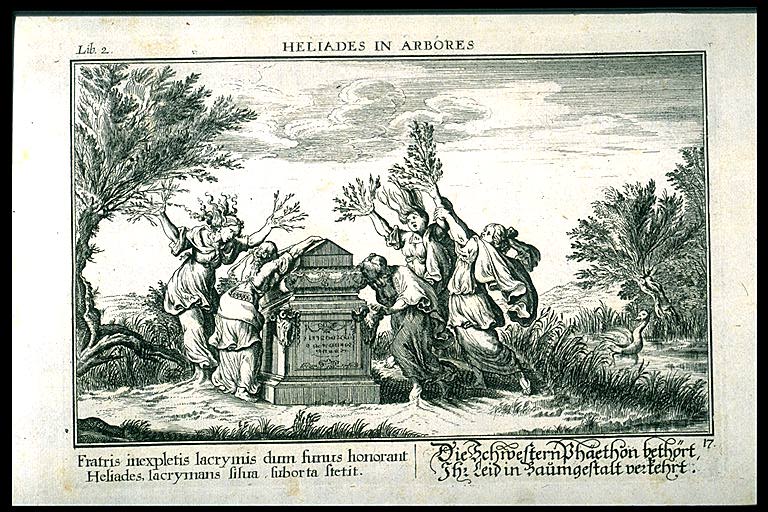
Lamenting Phaethon's death, his sisters, the Heliades wept bitterly. As punishment for encouraging Phaethon's reckless ride and for assisting him in yoking the steeds to the chariot, the Heliades became rooted to the spot and changed into poplar trees, from which tears continually fell. These tears became hardened by the sun and turned into amber.
Inscription à :
Articles (Atom)