Cognac
It is probably the most popular, recognizable and one of the most common color, cognac (or whisky) amber comes mainly in treated form (initially transparent yellow), but can be also natural. Slow heating deepens the color, makes it more shimmering and bright than natural. Cognac amber is often autoclaved (treated with high pressure saturated steam at about 120°C/248°F) which results in inner cracking. The steam penetrates the amber’s structure and alter its color. That’s how decorative bubbles (or so-called “scales”) and shiny discs are created. Heating is a very cold technique that has been in use for hundreds of years to enhance amber’s natural color while autoclaving has been developed in the second half of the 20th century. There are several shades of cognac amber, varying from light honey to dark cognac, almost cherry shade.
|
mardi 27 mai 2014
Amber Colors: from White to Black


jeudi 24 avril 2014
mardi 26 novembre 2013
Cherry Amber: Video
Before we post an article on Cherry Amber, its varieties, shades, treatment, etc, here is a short video of some of the pieces from our collection:
jeudi 10 octobre 2013
Baltic Amber Jewelry Giveaway
We've got a great review from Lilly who is launching a wonderful giveaway: one baby necklace and one matching adult necklace. Don't let it go!
http://livelaughlovewithlilly.blogspot.com/2013/10/amber-regina-baltic-amber-baby-adult.html

http://livelaughlovewithlilly.blogspot.com/2013/10/amber-regina-baltic-amber-baby-adult.html

samedi 5 octobre 2013
How To Buy Baltic Amber Jewelry Online
The Baltic Amber jewelry is getting more and more diverse and sophisticated. Every year one can find more variety in designs from very simple pieces to the most sophisticated combined with unusual materials like wood or antique silver and other stones or when huge nuggets are mounted in naturally looking settings. Thus, a number of stores which sell amber jewelry is multiplying every year. From the most astonishing Amberif, the largest jewelry fair devoted exclusively to the Baltic Amber jewelry which takes place in Poland every year, to small online stores that resell mass made jewelry through eBay. How to choose a quality piece out of hundreds of Internet stores which often offer the best prices?
You can find gorgeous amber jewelry through online stores. But make your shopping experience safe. There are several rules which a responsible and reliable vendor would follow:
1. Transparent Return Policy clearly indicated at the web site. Always make sure that you can return your piece of jewelry if you are not satisfied with your purchase. If the vendor offers only exchange or store credit, or even worse: no returns - be aware! The responsible vendor is interested not only in making profits, but in quality customer service (good example, Tiffany & Co return policy - 30 days). You will have time to test your piece of Baltic amber jewelry, wear it for a few days, see if it is as beautiful in reality as it is pictured online and decide whether you are happy with it.

2. Both Dimensions and Weight accurately added to the description. Sometimes vendors just indicate the length, and it may be enough for some customers. But if you want to know the width of the beads? Or even thickness which is often unclear from the photo. All these parameters must be dully described. The more accurate the dimensions, the more reliable (and hard working) the vendor. Weight is a crucial thing. Amber is sold by weight, so it is fair to let your customers know what it is worth, isn't it? Knowing the weight also helps better visualize the piece of jewelry (of course, only if you are familiar with amber). A tricky photographer is able to take such a shot that the tiniest piece of jewelry would look like a significant one.


3. Several images demonstrating all the details of the Baltic Amber jewelry. Are you satisfied with buying something having only its frontal view? Maybe yes, if it is a book or a skin lotion. But how about something which is intended for wearing? Or to be added to your collection of curiosities like amber with fossils? The more sophisticated the piece, the more pictures should be taken. Three at least, taken from different points of view. Ideally one image showing how it looks like on skin: a bracelet put on a wrist or a ring on a finger. All this will help you decide whether this piece would look great on you.
4. Natural or not? Nowadays the market is full of so-called "reconstructed, or "modified" amber, when an amber bead is made out of several small pieces of amber glued together. Natural Baltic Amber means that the piece of jewelry or a bead is carved out of one piece of amber. Natural Baltic Amber is always mined in Kaliningrad's area (Russia) and is never collected from the Baltic Sea shores as it is sometimes romantically described by some vendors. This detail is very important as the prices for natural and for pressed (reconstructed, modified) amber vary 2-5 times. For example, this vendor on eBay puts "modified" in the description without giving the details of whether it is made out of amber powder (lower quality) or out of small pieces of amber (higher quality).
5. Baltic Amber Balls, or Round Beads are in very high demand now. To give you a better idea about what is going on with prices, for instance, the price for natural Baltic Amber ball beads 10-15 mm in diameter are $13-15 per gram for whole sellers and only if you know the market very well and know where to get them at such a price. Smaller beads cost a bit less and larger ones more. In case you come across ideally round balls described as "natural not pressed not reconstructed amber" at much lower price, most likely the vendor lies to you. Or this amber was stollen or used. Price must be always your guide for the quality and genuineness. Large workshops that make such beads normally don't care to sell retail through the Internet with a very little mark-up.
6. Do you need a certificate of authenticity? The truth about the certificates is that it is a common misleading factor that a purchase of genuine Baltic Amber must be accompanied by a certificate of authenticity. Does a certificate guarantee that the amber is real? No. In theory, every company can provide a certificate of authenticity saying common phrases like "we guarantee that your piece of jewelry is made out of 100% natural Baltic Amber, etc". Every company can provide their own form of certificate and add it to the invoice to ensure their customers that they made the right decision. The point is that there is no superior authority that can verify their products and the certificates alike. Especially in the USA. In Europe, particularly in Poland and Lithuania, where there is a high concentration of amber workshops, the system is different. In a nutshell, the certificate of authenticity matters only if you are a wholesale vendor purchasing large quantities of amber goods from Lithuania and Poland.
7. Raw or Treated Baltic Amber? If you need amber necklace or bracelet for healing purposes, make sure that you buy raw amber as it has the highest concentration of the succinic acid. It can be polished or not. Polishing does not alter the healing properties of amber. All sparkling amber, with bubbles and discs as well as super translucent varieties and faceted beads are treated with heat, pressure, humidity, etc. The treatment makes the beads more appealing and pretty, but it decreases the amount of the succidic acid. Treated amber is still natural and, of course, real. It is a common confusion that real amber must be only raw. The reply is no. Baltic Amber has been treated in different ways for hundreds of years. As many other natural stones, amber often reveals its full beauty only after treatment.
8. From Europe or from the USA? There are many companies selling retail from Poland, Lithuania and also quite a few from the USA and also in Canada and Australia. Their prices vary, but generally speaking nowadays there is not much price difference between prices for Baltic Amber in the USA and in Eastern Europe (20% maximum). If you shop on eBay, you probably come across numerous "deals" of bulky expensive looking "amber" jewelry set in silver plated settings. This "jewelry" is manufactured in China and they certainly use pressed amber of the lowest quality. Look at this item: a "real amber" bracelet in "sterling silver" for $5.99 shipped for free from China.
You can find gorgeous amber jewelry through online stores. But make your shopping experience safe. There are several rules which a responsible and reliable vendor would follow:
1. Transparent Return Policy clearly indicated at the web site. Always make sure that you can return your piece of jewelry if you are not satisfied with your purchase. If the vendor offers only exchange or store credit, or even worse: no returns - be aware! The responsible vendor is interested not only in making profits, but in quality customer service (good example, Tiffany & Co return policy - 30 days). You will have time to test your piece of Baltic amber jewelry, wear it for a few days, see if it is as beautiful in reality as it is pictured online and decide whether you are happy with it.
2. Both Dimensions and Weight accurately added to the description. Sometimes vendors just indicate the length, and it may be enough for some customers. But if you want to know the width of the beads? Or even thickness which is often unclear from the photo. All these parameters must be dully described. The more accurate the dimensions, the more reliable (and hard working) the vendor. Weight is a crucial thing. Amber is sold by weight, so it is fair to let your customers know what it is worth, isn't it? Knowing the weight also helps better visualize the piece of jewelry (of course, only if you are familiar with amber). A tricky photographer is able to take such a shot that the tiniest piece of jewelry would look like a significant one.


3. Several images demonstrating all the details of the Baltic Amber jewelry. Are you satisfied with buying something having only its frontal view? Maybe yes, if it is a book or a skin lotion. But how about something which is intended for wearing? Or to be added to your collection of curiosities like amber with fossils? The more sophisticated the piece, the more pictures should be taken. Three at least, taken from different points of view. Ideally one image showing how it looks like on skin: a bracelet put on a wrist or a ring on a finger. All this will help you decide whether this piece would look great on you.
4. Natural or not? Nowadays the market is full of so-called "reconstructed, or "modified" amber, when an amber bead is made out of several small pieces of amber glued together. Natural Baltic Amber means that the piece of jewelry or a bead is carved out of one piece of amber. Natural Baltic Amber is always mined in Kaliningrad's area (Russia) and is never collected from the Baltic Sea shores as it is sometimes romantically described by some vendors. This detail is very important as the prices for natural and for pressed (reconstructed, modified) amber vary 2-5 times. For example, this vendor on eBay puts "modified" in the description without giving the details of whether it is made out of amber powder (lower quality) or out of small pieces of amber (higher quality).
5. Baltic Amber Balls, or Round Beads are in very high demand now. To give you a better idea about what is going on with prices, for instance, the price for natural Baltic Amber ball beads 10-15 mm in diameter are $13-15 per gram for whole sellers and only if you know the market very well and know where to get them at such a price. Smaller beads cost a bit less and larger ones more. In case you come across ideally round balls described as "natural not pressed not reconstructed amber" at much lower price, most likely the vendor lies to you. Or this amber was stollen or used. Price must be always your guide for the quality and genuineness. Large workshops that make such beads normally don't care to sell retail through the Internet with a very little mark-up.
 |
| Baltic Amber ball beads reconstructed from several pieces of amber. In this case it is very hard to tell the difference. |
7. Raw or Treated Baltic Amber? If you need amber necklace or bracelet for healing purposes, make sure that you buy raw amber as it has the highest concentration of the succinic acid. It can be polished or not. Polishing does not alter the healing properties of amber. All sparkling amber, with bubbles and discs as well as super translucent varieties and faceted beads are treated with heat, pressure, humidity, etc. The treatment makes the beads more appealing and pretty, but it decreases the amount of the succidic acid. Treated amber is still natural and, of course, real. It is a common confusion that real amber must be only raw. The reply is no. Baltic Amber has been treated in different ways for hundreds of years. As many other natural stones, amber often reveals its full beauty only after treatment.
 |
| Natural Baltic Amber set treated with pressure and heat |
vendredi 6 septembre 2013
Baltic Amber Drops, or Nodules
Among the variety of amber one can come across so-called amber drops (5%), or amber nodules. They are the overdose of resins that broke away from the streams, which used to flow through icicles and trunk.

lundi 2 septembre 2013
For the love of amber necklaces
I came across this great picture which is a perfect illustration of how light-weight amber jewelry is!
 |
| from http://thisbeadifulworld.tumblr.com/page/2 |
lundi 19 août 2013
Some exciting findings: Villa Giulia (Rome)
 |
Nymphaeum Loggia by Ammanati |
 |
| The Tunnel Vault of the Semicircular Portico (Loggia) at the rear of the Casino by the architect Vignola |
The Castellani's collection of the Etruscan jewelry was, unfortunately, closed. Nonetheless, it was exciting to find a few wonderful pieces of amber jewelry from the Etruscan tombs.

These two pieces are crafted out of gold and amber (most likely Sicilian amber which has a distinctive red hue). At that time amber and gold had the same value. These bulky jewelry was used as pins and were fixed with the bronze pins. The donuts at the same photo are also carved out of amber and (maybe) were worn on the pins.

This restored necklace is a similar example of the popular amber-gold combination in Etruscan jewelry.
mardi 23 avril 2013
Baltic Amber Cuff Links
It took me a while to decide how to increase my amber collection, more in a male direction. It also took me a while to find baltic amber cuff links. I've never come across really beautiful cuff links. They are usually either boring chunks of amber in tribal style set in silver or quite simple pieces inlaid in a mosaic like thing. My friend from Poland has spent all his life (twenty five or so years) perfecting the mosaic technique in amber jewelry. His creations are not only perfectly inlaid with an ideal mirror like surface when one cannot feel the border between amber and silver. He is also the only one who is able to create cuff links that work like little sculptures. Each pair has an individual profile: a pyramid, an arch, a diamond, a triangle, etc. I could not resist and ordered one pair for my husband to ... match my jewelry!


jeudi 28 février 2013
New collection: Baltic Amber Bracelets from Poland
We've got several truly precious pieces handcrafted by artisans from Poland.
Each bracelet has a central amber cabochon set in sterling silver frame. All bracelets are 7 inch (18 cm) in diameter and have a secured chain lock. It is easy to put on, and you will certainly never loose it.


Each bracelet has a central amber cabochon set in sterling silver frame. All bracelets are 7 inch (18 cm) in diameter and have a secured chain lock. It is easy to put on, and you will certainly never loose it.


vendredi 22 février 2013
Amber from Sicily
This gorgeous necklace is several thousands years old. There used to be deposits of amber close to Mount Etna, in Sicily. That amber was mined out by the 18th century. This is an example of exquisite craftsmanship from Etruria. Sicilian amber has a distinguished red hue and, unlike Baltic amber, is opaque. Nowadays Sicilian amber's almost impossible to purchase; it can be mainly found in museum collections.
 |
| Necklace with a pendant Scarab, Italic or Etruscan, 550-400 B.C. Amber, gold and carnelian scarab. Length: 39.5 cm (15 inch) Los Angeles, The J. Paul Getty Museum. |
What is Amber
I am very pleased that Cattie Coyle invited me to write an article in her blog on Baltic Amber.
Check it out!
Check it out!
 |
| Baltic Amber pendant with a mosquito |
mardi 5 février 2013
15% off in February!
Take your chance of great prices on Baltic amber jewelry!
15% off in February for orders over $100. Coupon february777
www.amberregina.com

mardi 6 novembre 2012
November's promotion from Amber Regina
This November's promotion: 10% off any order. No minimum order value!
Coupon - november50 at check-out.
www.amberregina.com

Coupon - november50 at check-out.
www.amberregina.com

vendredi 2 novembre 2012
Travel Protection Charms
For those who are searching for a cute protection charm while traveling, this is a nice article from Cattie
http://charmsguide.net/travel-protection-charms/

http://charmsguide.net/travel-protection-charms/

dimanche 28 octobre 2012
Baltic Amber Baby Teething Necklace
Thanks to Ashley we've got another great review of our Baltic amber baby teething necklaces
http://www.amberregina.com/category_13/Baltic-Amber-Baby-Teething-Necklaces.htm
 |
| Baltic amber baby teething necklace in multicolor beads |
mercredi 17 octobre 2012
Amber Regina coupon, October 2012
Get 15% off on Baltic amber jewelry orders over $100 till the end of October!
Voucher: amberoctober
www.amberregina.com
www.amberregina.com
For coupons and promotions follow us on Facebook
Voucher: amberoctober
www.amberregina.com
 |
| Baltic Amber butterscotch bracelet |
For coupons and promotions follow us on Facebook
dimanche 14 octobre 2012
How Is Amber Produced?
Several
factors affect the production of amber from resin, a process known as
amberization. Once the resin is exuded it hardens. Resin contains liquids such
as oils, acids and alcohols, including the aromatic compounds that produce the
distinctive resinous smell – two examples of highly aromatic resins are
frankincense and myrrh. Scientists call these liquids volatiles and they
dissipate and evaporate from the resin. The resin then undergoes a process
known as polymerization, whereby the organic molecules join to form much larger
ones called polymers. Hardened resin is known as copal. Copal becomes
incorporated into soil and sediments where it remains long after the tree dies.
It continues to polymerize and lose volatiles until the resultant amber is
completely polymerized, has no volatiles and is inert.
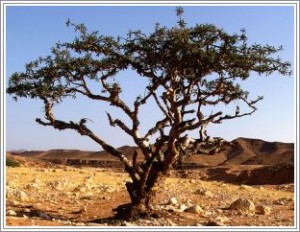 |
| Frankincense tree |
Many
scientists thought that time was important in the fossilization of resin to
produce amber, and the amberization process was estimated as taking between 2
and 10 million years. However, it now appears that many more factors are
involved. Most amber in deposits around the world was not formed where it is
found – the copal or amber has been eroded from the soil, transported by rivers
and deposited elsewhere. For instance, amber from Borneo
is 12 million years old and comes from sand and clay sediments that were
deposited in a deep ocean. The fossilized resin from Borneo
that comes from beds of sandstone is completely inert and undoubtedly amber. However,
resin that comes from beds of clay still contains volatile components, which
means that it is still copal. So, the type of sediment in which the resin is
deposited is much more important than time for amber formation. But what is not
so clear is the effect of water and sediment chemistry on the resin.
 |
| Resin oozing from under the bark of a cedar tree, where a branch has been sawn off |
From Amber:
The Natural Time Capsule
By Andrew
Ross
dimanche 30 septembre 2012
Today is the last day of free shipping for all orders from Amber Regina
www.amberregina.com
Use the coupon shipping55 at checkout
Follow us of Facebook for future deals and promotions!
www.amberregina.com
Use the coupon shipping55 at checkout
Follow us of Facebook for future deals and promotions!
Amber : Talismanic, Amuletic and Folk Medicine
Since time
immemorial, amber has been worn as an amulet in the Baltic as well as the
Mediterranean cultures. The people of these cultures believed amber was
especially beneficial for protecting infants from the croup when worn as a
necklace in the form of an amulet. As a charm, amber was believed to ward of
fits, dysentery and nervous afflictions. As early as Pliny’s time, farmers
wives in areas where the “water had properties that would harm the throat”, or
was deficient in iodine, wore raw amber beads around their necks as a remedy
against swellings (goiter).
 |
| raw baltic amber butterscotch beads |
The lore
attributing guardian values to amber has lasted into the 20th
century. During the late 1960s, for example, an authority announced the virtues
of wearing amber beads around the throat to protect it from diseases. It was
believed that the strong electrical properties of amber resulted in an
electrical band forming around the throat and bringing into existence a
protective power. Even today, in many of the peasant areas of the Baltic, amber
earrings and necklaces are worn when one has a headache or a throat ailment.
Amber is
thought to possess other unusual curative powers. In ancient times, amber was
powdered and mixed with honey and oil-of-roses for curing ear troubles. When
mixed with honey from Attica , it was a cure
for dimming eyesight. The powder was taken internally as a remedy of diseases
of the stomach, whereas the amber oil was prescribed for internal
administrations of asthma and whooping cough. Simply holding a ball of amber in
the hands not only kept one cool during the hottest days of summer, but would
reduce the temperature of a person from fever.
 |
| yellow lemon amber nugget |
Many
prescriptions were written which included amber along with other gemstones. An
old meteria medica lists 200
medicinal stones. A dose suggested for heart disease contained white amber, red
coral, crab’s eyes, powdered hartshorn, pearls and black crab’s claws. Such a
mixture was the prized Oriental Bezoar, prescribed for different ailments.
Amber was
also used externally as a fumigation to cure other ailments, including
tonsillitis, catarrh, or running nose and eyes. It was thought that the smell
of burned amber helped women in labor. In the Orient, amber fumigation was
accomplished by throwing powdered amber on a hot brick. The fumes would
strengthen the individual and give him courage from the soul of the tiger, a
beast second in importance only to the dragon in Chinese mythology. “Syrup of
amber”, a mixture of liquid acid-of-amber and opium, was also used in China
 |
| powdered Baltic amber |
A piece of
amber placed on the nose was thought to stop excessive bleeding. It is perhaps
this belief in the special blood-stilling or coagulating properties of amber
that explains the use of an amber handle on the ritual Jewish circumcision
knife of the 18th century. During the early 1900’s, as medical
practices advanced, vessels made of compressed amber were used during blood
transfusion. The amber, being a poor conductor of heat, kept a more constant
blood temperature for a longer period of time that did glass or stone vessels,
and thus the blood was kept from coagulating.
The
persistent belief that amber not only prevented infections, but acted as a
charm against them, was the reason amber retained its popularity into the late
1800s and early 1900s, especially in the smoking articles industry. Its
employment as a mouthpiece for cigars, cigarettes and pipes was originally
talismanic. Amber was used in the Middle East
for the mouthpieces of hookahs with their many hoses because of the gemstone’s
supposed germicidal effect.
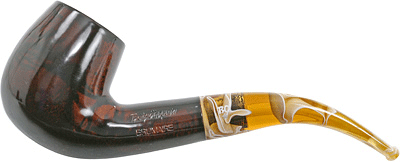 |
| Butz-Choquin Brumaire pipe in amber |
Inscription à :
Articles (Atom)